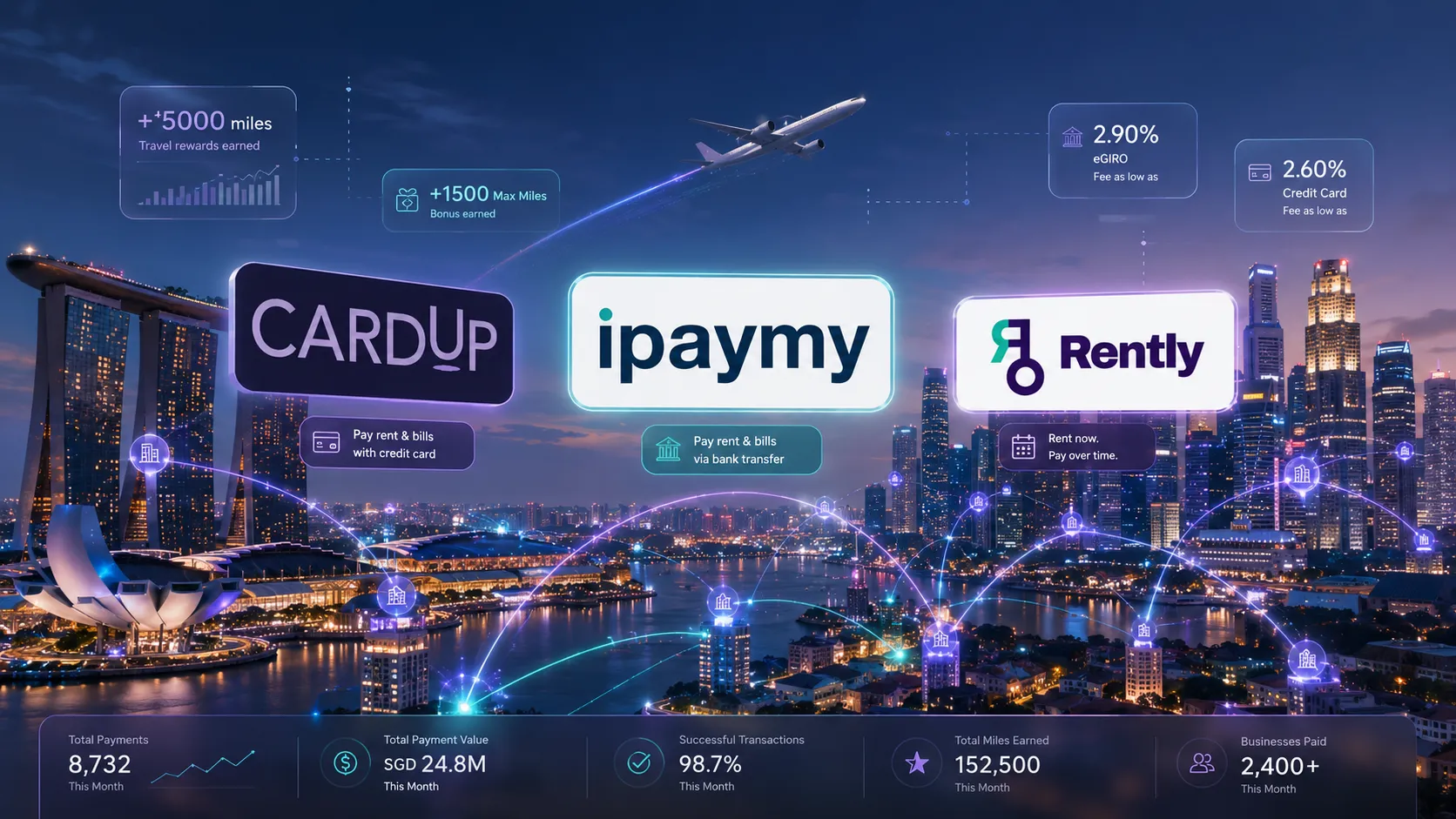
Comparing rent payment options: CardUp, ipaymy and Rently
For renters in Singapore, the right rent payment option depends on what they are trying to optimise for.
Some renters mainly want the lowest possible fee. Others are willing to pay a higher fee if the miles, cashback or convenience value makes sense. Some may simply want to automate rent payments so they do not need to remember manual transfers every month.
The important point is that these options are not identical. CardUp and ipaymy are broader payment platforms that can be used for different types of bills and payments. Rently is more specifically focused on rent payments and gives renters a choice between eGIRO and credit card.
That flexibility matters because the best option may be different depending on the renter’s goal.
CardUp
CardUp allows users to make payments by credit card, including rent payments and other types of expenses.
According to Sethisfy's article from 30th May 2026, CardUp is increasing its standard fee for Singapore-issued credit cards from 2.60% to 2.90% from 13 June 2026.
CardUp may also offer promotional rates in some cases. These promotional rates can be attractive, but renters should check whether they apply to their specific payment, card, amount and date.
For renters using CardUp, the main things to check are the applicable service fee, whether any promotion applies, how long the payment takes to process, and whether the chosen credit card earns rewards on the transaction.
ipaymy
ipaymy also allows users to make payments by credit card, including rent payments and other expenses.
According to Sethisfy, ipaymy is increasing selected fees for Singapore-issued Visa cards from 11 June 2026. One-time Visa payments are reported to increase from 2.40% to 2.95%, while recurring Visa payments are reported to increase from 1.85% to 2.60%.
Sethisfy also notes that Mastercard pricing may differ. This means renters should not assume the same fee applies to every card network or payment type.
For renters using ipaymy, the main things to check are whether they are paying with Visa or Mastercard, whether the payment is one-time or recurring, whether a promotional code applies, and whether their credit card earns rewards on the transaction.
Rently
Rently is more specifically focused on rent payments and gives renters payment method flexibility through both eGIRO and credit card options.
Rently's eGIRO plans cost 0.7% (Basic), 1.7% (Standard) or 2.8% (Premium) and earn Max Miles. Credit card payments cost 2.9% for Singapore-issued Visa and Mastercard, or 3.9% for Amex and cards issued outside Singapore.
The key difference is how rewards may be earned.
With eGIRO, renters earn HeyMax Max Miles on rent: 0.4, 1 or 1.7 per $1 depending on the plan. No credit card is involved, so there are no card miles on top.
With credit card, renters earn only their own card's rewards, depending on their bank's reward programme and card terms. Card payments through Rently do not earn Max Miles.
Rently's card fee depends on the card: 2.9% for Singapore-issued Visa and Mastercard, and 3.9% for Amex and any card issued outside Singapore.
eGIRO vs credit card: Max Miles or card rewards?
Rently’s eGIRO and credit card options are designed for different renter priorities.
The eGIRO option may suit renters who want to keep fees lower, automate monthly rent payments, and earn HeyMax Max Miles from rent. With Premium at 1.7 Max Miles per $1, it is also the higher-earning option for most renters, whose credit cards often earn little or nothing on rent.
Another benefit of eGIRO is convenience. Once the payment is set up, renters do not need to manually make the rent payment every month. This can reduce the risk of forgetting a payment or having to repeat the same transfer process each month.
The trade-off is that eGIRO earns only Max Miles; you don't collect credit card points on the same payment.
The credit card option may suit renters whose card earns well on rent payments. With Rently's credit card option, renters earn their card's miles, subject to the bank's reward rules, but not Max Miles.
However, credit card payments come with a fee of 2.9% (3.9% for Amex and cards issued outside Singapore). Renters should not look only at the number of miles earned. They should compare the service fee paid against the realistic value of the miles earned.
In simple terms, eGIRO is the way to earn Max Miles, with fees from 0.7%. Credit card may suit renters whose card rewards on rent are worth more than the 2.9% fee.
Promotional rates vs standard pricing
Another factor to compare is whether the fee is a standard rate or a promotional rate.
According to Sethisfy, CardUp and ipaymy may offer promotional rates or codes in some situations, including new-user promotions or card-specific promotions. These can make the effective fee more attractive for a particular payment.
However, promotional rates are usually time-limited or subject to specific terms. They may apply only to certain users, cards, payment types, transaction sizes or dates.
Rently prices by payment method: eGIRO plans from 0.7%, and credit cards at 2.9% (3.9% for Amex and cards issued outside Singapore). Rently does not rely on time-limited promotional rates in the same way.
That does not automatically make one model better than another. Promotional rates can be valuable when they apply. Standardised pricing can be easier to understand and compare. Renters should check the rate they personally qualify for before deciding.
How to compare rent payment options fairly
The most accurate way to compare rent payment options is to simulate the same rent amount across different platforms.
Before choosing a platform, renters should try each provider’s calculator and enter their monthly rent amount, preferred payment method, specific credit card if paying by card, and any promotional code they are eligible for.
They should also check the expected miles, cashback or rewards from their bank, as well as the service fee charged by the platform.
This matters because the best result depends on the renter’s actual situation. A platform with a higher headline fee may still make sense if the user earns enough rewards to offset the cost. A lower-fee option may be better for someone who values automation and simplicity more than maximising miles.
As a rule of thumb, renters should compare the dollar cost of the fee against the realistic value of the rewards earned. If the rewards value is lower than the fee, the payment may not be worth it from a rewards perspective. If the rewards value is higher than the fee, it may be worth considering.
Key takeaway
The reported CardUp and ipaymy fee increases in June 2026 make it more important for renters to compare the total cost of paying rent through different platforms.
CardUp and ipaymy may still be useful options, especially when promotional rates apply or when users want a broader bill payment platform.
Rently may be worth comparing for renters who want rent-specific payment flexibility, including both eGIRO and credit card options.
For renters who want lower fees, automation and Max Miles, eGIRO is the practical choice. For renters focused on their own card's miles, credit card payments may make sense, but only if those card rewards justify the 2.9% (or 3.9%) fee.
The best option is not the same for everyone. Renters should use each platform’s calculator, check their own credit card reward rules, and compare the total cost before making a payment.